Whole Health London: Phase 2
This project aims to support migrant domestic abuse survivors in feeling safer and better supported when using health services across London.
Welcome to our brand new website, providing you with easier access to our training, research and resources!
Phase one of the Whole Health London project was an initiative funded by the City Bridge Foundation, which ran from July 2020 to June 2023. The project maps the domestic abuse response within health settings in the capital and makes recommendations for the most effective means of securing a whole-health response which truly meets the needs of all victims and survivors.

London is a leader in health-based domestic abuse innovation, with significant investment in the capital, notably through the Violence Reduction Unit (VRU) in primary care settings and the Mayor’s Office for Policing and Crime (MOPAC)’s uplift funding for Independent Domestic Violence Advisors (IDVAs) in hospital settings. However, gaps remain in provision across London and we know there is more to do to improve the response to survivors of domestic abuse to get them safer sooner, as well as to reduce the costs of a crisis response at a later stage.
Read the Whole Health London report: We only do bones here
For the full findings and further details, see the full report ‘We Only Do Bones Here’.
Survivor, HaveringI had so many medical and mental health issues because of the abuse. It was all documented but never was I asked or signposted. Only when I fled I told my GP, his reply was ‘why didn’t you just leave?'
Domestic abuse has a profound impact on our physical and mental health. It is vital that health services are an active part of the solution to give victims the help they so urgently need.
The Whole Health London project builds on the findings of the Pathfinder Project, which sought to embed a ‘whole health’ approach to domestic abuse in eight sites across England.
We are calling for a ‘whole health’ approach to create better provision for survivors in all health settings, across all London boroughs. This strategy will mean over-stretched healthcare professionals will receive the support they need to adequately help victims, and victims won’t face a postcode lottery when it comes to accessing services.
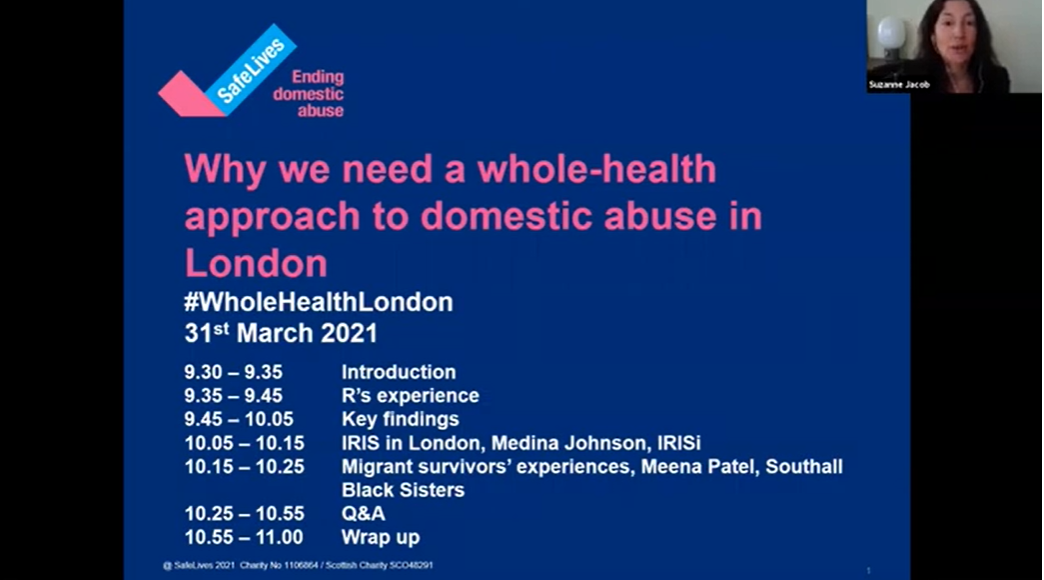
Re-watch our Whole Health London report launch and key findings presentation. Date: 31st March 2021.
Speakers included:
You can also download the slide deck, chat transcript and the event Q&A.


Sign up to receive our monthly newsletters about the latest training, events, research and fundraising initiatives at SafeLives. Together, we can end domestic abuse, for everyone, for good.